Carbon accounting without the spreadsheet chaos. CO2 reduction that pays off.
-
Save 50% of the time with automation — rather than navigating through complex data.
-
Reduce CO2 emissions by 20% or more with clear levers and targeted measures.
-
TÜV-certified — trusted by customers, banks, and auditors.
leadity. lead with clarity.
Carbon accounting with leadity
Automated carbon accounting — compliant with the GHG Protocol
Built on over twelve years of experience in carbon accounting and more than 200 successfully completed carbon balances. Your CO2 accounts are automatically integrated into your wider reporting. leadity combines carbon accounting and sustainability management in a single system.
-
Guided onboarding, fast data entry: Quick data capture through selection options and pre-built data templates.
-
Calculation of all Scope 1, 2 & 3 emissions: A comprehensive footprint of your organisation and its value chain.
-
Automated, efficient calculation: Automated data collection via integrations and calculation through linked CO2 databases.
-
Robust, audit-ready accounting: CSRD-compliant in accordance with the Greenhouse Gas Protocol and ISO 14064-1.
Legally compliant accounting in accordance with ESRS
CO2-Reporting and -Management
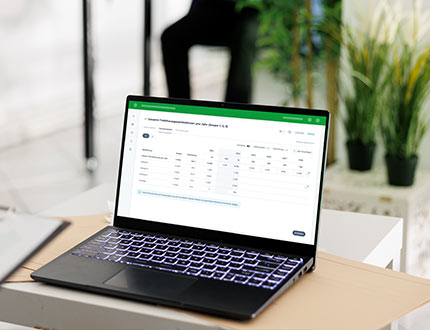
Intuitive dashboards make your emissions visible at a glance. Identify which areas of your operations are the largest CO2 emitters — and take targeted action to decarbonise.
Integrations with existing systems and metrics enable automated data collection. Pre-loaded baseline values for materials, services, transport emission calculations, and more simplify manual entries. Your emissions data is automatically assigned to Scope 1, 2, or 3.
From small SMEs to global corporations
Whether it’s retail, services, or manufacturing
Pre-integrated leading emissions databases — including Ecoinvent, GEMIS, DEFRA, the fjol climate database, and many more — make it straightforward to calculate your individual emissions in detail.
All carbon accounts can be externally validated by independent third parties with minimal effort. The calculation methodology is additionally being certified by TÜV Rheinland (third-party validation).
leadity AI features at a glance
AI power exactly where ESG & ISO otherwise mean grinding manual work
Our clea AI handles the complexity. You stay in control. Your data stays in Germany.
Encrypted, stateless, no third-party training. AI only where it truly makes a difference — we mean it


Software-based carbon accounting for businesses
leadity simplifies your carbon accounting
Legally compliant with your CSRD reporting — in accordance with the Greenhouse Gas Protocol and ISO 14064. Calculate your corporate carbon footprint and have it automatically integrated into your wider sustainability reporting. No duplication of effort — efficient by design. We would be happy to walk you through the benefits in a personalised demo.
Your carbon accounting software
Additional software features
Carbon accounting is just one of many integrated modules within the leadity software. From strategy and sustainability management to ESG reporting — leadity offers a comprehensive range of features to make your sustainability management more efficient.


FAQs on ESG reporting & management
Questions and answers on ESG reporting
If you have any further questions about ESG strategy, management, or reporting in leadity, please feel free to reach out to us at kontakt@leadity.de
In Germany and the European Union, certain companies are legally required to produce a carbon account:
- Energy-intensive companies: Companies participating in the EU Emissions Trading System (EU ETS) are required to report their greenhouse gas emissions. This primarily affects energy-intensive sectors such as steel, cement, chemicals, and energy generation. Companies falling under the Carbon Border Adjustment Mechanism (CBAM) are also required to account for the CO2 values of certain imported goods.
- CSRD-obligated companies: All companies meeting the criteria of the EU Non-Financial Reporting Directive (NFRD) are required to submit a carbon account under the updated CSRD. This generally applies to companies with more than 500 employees that are of public interest — such as listed companies.
- Companies producing voluntary reports (e.g. VSME): Many companies produce carbon accounts on a voluntary basis — to demonstrate where CO2 reduction progress is being made, or to meet the requirements of investors and customers. VSME reporting also requires the systematic collection and disclosure of Scope 1 to 3 emissions.
- Sector-specific regulations: Certain industries are subject to their own regulations or agreements regarding CO₂ reporting. Large real estate companies, for example, are required to collect and disclose specific data.
Link to CSRD: The European Union’s Corporate Sustainability Reporting Directive (CSRD) expands and deepens the requirements for sustainability reporting. It applies to all large companies as well as all listed companies, with the exception of micro-enterprises. Companies are required to disclose detailed information on environmental factors, social and employee matters, human rights, anti-corruption, and — in particular — climate and CO₂ emissions. Reports must be prepared in accordance with the European Sustainability Reporting Standards (ESRS) and audited by independent third parties. The CSRD also promotes digital reporting, improving the comparability and transparency of sustainability data, including CO₂ emissions.
The CSRD not only requires companies to produce a carbon account, but also to publish it in a standardised, auditable, and detailed format — contributing to more effective monitoring and reduction of CO₂ emissions.
Scope 1, 2, and 3 emissions are categories used to classify a company’s greenhouse gas emissions in accordance with the Greenhouse Gas Protocol — a globally recognised standard for measuring and managing greenhouse gases. Below is an overview of the individual emission categories across the three scopes:
Scope 1: Direct emissions
Scope 1 covers all direct emissions arising from sources within the company’s boundaries that are directly controlled by the organisation. These include:
- Combustion of fossil fuels in company-owned or controlled facilities, such as boilers, vehicles, and production equipment.
- Process emissions from industrial processes, such as the production of cement or steel.
- Fugitive emissions from sources such as leaks in refrigeration systems or the use of chemical compounds.
Scope 2: Indirect emissions from energy consumption
Scope 2 covers indirect emissions arising from the consumption of purchased energy. This includes:
- Electricity consumption: Emissions generated during the production of electricity purchased by the company.
- District heating and cooling: Emissions from the generation of heat or cooling energy consumed by the company but not produced on-site.
Scope 3: Other indirect emissions
Scope 3 covers all other indirect emissions occurring along the company’s value chain — both upstream and downstream. Examples include:
- Upstream emissions: Emissions from the production and transport of purchased goods and services, business travel, employee commuting, and waste disposal.
- Downstream emissions: Emissions from the use and disposal of products sold by the company, as well as transportation and distribution.
Capturing and managing Scope 3 emissions is often more complex than Scope 1 and 2, as it involves a wide range of external processes and stakeholders.
This categorisation helps companies develop a more comprehensive understanding of their total emissions — covering not only direct and controllable emissions (Scope 1 and 2), but also the broader indirect emissions across their value chain (Scope 3).
Carbon accounting with leadity offers a range of significant advantages:
1. Time and cost savings
- Increased efficiency: leadity accelerates the process of data collection and analysis, reducing workload and enabling faster report generation.
- Cost reduction: Thanks to the automation built into leadity and the reduction of manual processes, you can significantly lower the cost of your carbon accounting.
2. Precision and efficiency
- Automation: leadity automates data collection and processing, reducing human error and improving the accuracy of results.
- Data integration: Data from a wide range of sources and systems can be integrated, providing a more comprehensive and accurate picture of your emissions.
3. Compliance and standardization
- Regulatory compliance: leadity ensures that your reporting meets all legal and regulatory requirements, including those of the CSRD (ESRS) and ISO 14064.
- Standardised reporting: leadity also ensures compliance with international standards and frameworks, such as the GHG Protocol (Greenhouse Gas Protocol), improving the comparability and consistency of your data.
4. Sustainability management and decision-making
- Analysis and reporting: leadity enables companies to generate detailed reports and analyses, helping them gain a clearer understanding of their emission sources and manage them more effectively.
- Strategic planning: leadity supports strategic planning and management of sustainability initiatives by identifying reduction opportunities and tracking progress over time.
- Data visualisation: leadity provides visual representations of emissions data, making it easier to understand and communicate results.
5. Scalability
- Flexibility: As a sustainability management system, leadity is scalable and can be tailored to your individual needs.
- Future-proofing: The leadity software enables you to continue and expand your carbon accounting as data volumes grow and requirements evolve.
- Consolidation: The group function allows carbon accounts from multiple locations and entities to be consolidated automatically. A single central platform ensures consistent data across the board.
By using leadity for your carbon accounting, you can measure, monitor, and report your greenhouse gas emissions more efficiently and effectively — supporting both regulatory compliance and the achievement of your sustainability targets.
We would be happy to show you in detail how it works.
Book a no-obligation software demo here
The Greenhouse Gas Protocol (GHG Protocol) is a comprehensive global standard for measuring and reporting greenhouse gas emissions. Developed by the World Resources Institute (WRI) and the World Business Council for Sustainable Development (WBCSD), it serves as the foundation for numerous national and international greenhouse gas inventory programmes. The GHG Protocol provides guidelines and tools for companies and governments to produce greenhouse gas accounts and supports them in setting and achieving reduction targets.
The key components of the GHG Protocol include:
- Corporate Standard: Guidelines for companies on producing a comprehensive greenhouse gas account, including the categorisation of emissions into Scope 1, 2, and 3.
- Project Protocol: A framework for quantifying greenhouse gas emission reductions from specific projects.
- Value Chain (Scope 3) Standard: Guidelines for reporting emissions across a company’s entire value chain.
ISO 14064-1
ISO 14064-1 is part of the ISO 14064 series of standards and provides an internationally recognised framework for quantifying and reporting greenhouse gas emissions at the organisational level. Published by the International Organization for Standardization (ISO), it serves as an important complement to the guidelines of the GHG Protocol.
Key features of ISO 14064-1 include:
- Clearly defined requirements: Specifications for producing greenhouse gas accounts, including the identification of emission sources, the selection of data collection methods, and the reporting of emissions.
- Reliability and transparency: Guidelines for ensuring the accuracy and consistency of reported data, as well as transparency in the methods and assumptions applied.
- Reporting and verification: Requirements for the internal and external review of emissions data, strengthening the credibility and reliability of reports.
ISO 14064-1 is designed to help organisations systematically capture and manage their greenhouse gas emissions — supporting the achievement of sustainability targets and compliance with regulatory requirements.
Summary
The Greenhouse Gas Protocol and ISO 14064-1 provide standardised approaches to measuring, reporting, and verifying greenhouse gas emissions. Both standards contribute to improved environmental reporting and the promotion of sustainable practices. With leadity, you automatically meet both standards — in close alignment with their requirements.
CO2-Management with leadity
Report your CO2 emissions efficiently and digitally with leadity
Capture and calculate all your emissions with the support of leading emissions databases. Automated integrations and robust baseline values give you a detailed overview of your CO₂ emissions — see our software in action for yourself.