
EcoVadis: What companies need to know for a strong score
More and more companies are using EcoVadis to have their sustainability performance assessed independently. As a result, the EcoVadis rating has become an important benchmark for sustainability worldwide. But what is behind EcoVadis certification? And above all: How can companies achieve a strong EcoVadis score?
13.04.2026
5-minute read
Sustainability is not a trend, but the way forward. That is exactly where EcoVadis comes in: The international platform evaluates companies based on their sustainability performance. The assessment is built on environmental, social, and governance criteria. In doing so, EcoVadis analyses both internal processes and external supporting evidence to assess sustainability across the entire value chain.
Is EcoVadis an ESG rating?
Yes, EcoVadis is an ESG rating. EcoVadis sustainability ratings take the three ESG dimensions – environment, social, and governance – into account very comprehensively when assessing a company. Based on these criteria, companies receive a transparent view of their sustainability performance.
Who is behind EcoVadis?
EcoVadis is a software-as-a-service company that offers a range of sustainability solutions, including sustainability ratings. The company was founded in Paris in 2007 and, according to its own information, has already assessed around 150,000 companies in more than 185 countries and employs around 1,700 people.
A common misunderstanding: EcoVadis is not a certificate or seal
There are still some misunderstandings in the market around sustainability ratings, which is also due to the wide range of providers and the different methods of verification. What is important to know is that an EcoVadis score is not a formal certificate, but proof of assessment. However, the term “EcoVadis-certified” is often used colloquially when a company has received a medal (Bronze, Silver, Gold, Platinum).
In fact, the EcoVadis rating shows that a company has completed the EcoVadis assessment process with a specific result. These EcoVadis ratings can be communicated publicly and serve as proof of quality for customers and partners.
How EcoVadis works
To demonstrate a company’s sustainability efforts, the EcoVadis process is comparatively straightforward, yet thorough. The assessment process is standardised and digital: Companies register on the EcoVadis platform and complete a comprehensive questionnaire covering their sustainability strategy, company policies, implemented measures, and performance metrics.
These statements must be supported by evidence documents. EcoVadis reviews the information and evaluates it using a scientifically grounded model. From 21 criteria defined by EcoVadis, the platform selects those most relevant to the respective company and creates a scorecard based on its assessment.
What is the EcoVadis scorecard?
The EcoVadis scorecard is the central outcome of the sustainability assessment carried out by EcoVadis. It shows at a glance how well a company meets the sustainability criteria defined by EcoVadis. Scores between 0 and 100 highlight both strengths and areas for improvement. The assessment is carried out across four main topic areas.
The four themes of the EcoVadis assessment are:
-
Environment: The focus here is on environmental protection, resource use, emissions, waste management, and climate action measures.
-
Labour and human rights: This area covers topics such as working conditions, occupational health and safety, equality, non-discrimination, and measures against forced or child labour.
-
Ethics: This includes measures against corruption and bribery, fair business practices, and responsible information management.
-
Sustainable procurement: EcoVadis analyses sustainability across the supply chain, including how suppliers are selected and monitored against social and environmental standards.
Each category is assessed individually, and there is also an overall score between 0 and 100 points. Based on this score, EcoVadis awards a medal depending on the threshold reached: Bronze, Silver, Gold, or Platinum.
The scorecard also includes benchmark comparisons with companies in the same industry and highlights potential areas for improvement. But the EcoVadis scorecard is not only useful for internal analysis. It is especially valuable for demonstrating a company’s sustainability performance to customers, investors, and partners. It is often used in supply chains to create transparency and build trust.
EcoVadis scoring: These ratings you can achieve
As with any rating, the key question is: What counts as a good score? EcoVadis ratings reflect the quality of a company’s sustainability management system at the time of assessment, using a score between 0 and 100. The higher the score, the better.
The quality of an EcoVadis rating can be seen clearly through the medals awarded. Since 1 January 2025, medals have been awarded based on percentile thresholds rather than fixed score ranges.
-
Platinum medal – the top 1%
-
Gold medal – the top 5%
-
Silver medal – the top 15%
-
Bronze medal – the top 35%
A company’s percentile rank is calculated at the time the scorecard is published and is shown on the scorecard. EcoVadis compares the company’s performance with all companies in its database that have been assessed within the previous 12 months. In other words, the percentile rank is not calculated by industry, but across all rated companies.
What are the key factors for achieving a strong rating?
Companies that want to perform well in the EcoVadis rating can prepare in advance. To achieve a strong EcoVadis score, companies should therefore pay close attention to the following 10 points in particular:
1. Documentation plays a central role: EcoVadis does not assess statements of intent alone, but measurable supporting evidence. Companies should document and upload policies, KPIs, certificates, reports, and audit results.
2. Make sure your information is current and consistent: Outdated or contradictory information does not count. All data must be consistent, up to date, and traceable.
3. Measures should not just be mentioned in general terms. Their concrete link to a specific sustainability topic should be clearly stated.
4. As many sustainability topics as possible should be covered by verifiable measures.
5. Sustainability certifications can improve your EcoVadis score, for example ISO 14001 for environment or ISO 45001 for labour and human rights. Valid certificates must be submitted.
6. EcoVadis places strong emphasis on how a company manages sustainability through policies, processes, and reporting. This is where disciplined, well-structured work matters.
7. Sustainable procurement is a key stand-alone topic in EcoVadis. Companies should therefore integrate their suppliers into their sustainability strategy.
8. Manage risks actively: EcoVadis carries out public monitoring that feeds into the assessment. Negative public incidents such as environmental violations, human rights lawsuits, or corruption cases can significantly lower the score. Companies should therefore actively assess potential risks. Media monitoring can also be useful to respond quickly to allegations.
9. Action plans: EcoVadis assesses whether risks, for example in the supply chain, have been identified and whether measures to reduce those risks have been planned. Proactive strategies are especially valuable.
10. Companies are reassessed every year. If they can demonstrate concrete progress during the reassessment, their score can improve — for example, if the share of reviewed suppliers increases.
Soft factors can also improve the score
Typically, the required evidence has to be requested from different departments and systems or created individually. In some cases, it is simply not recognised during the search. This costs time, ties up personnel, and creates unnecessary coordination effort. This is where an ESG platform is the right choice.
With the leadity solution, you can save up to 80 percent of the time required to complete the questionnaires. Thanks to our single source of truth approach, all information is available centrally — with no search effort and no coordination overhead. In addition, you can improve your score when your evidence is audit-proof and traceable. Evidence stored in leadity meets these requirements and aligns with leading standards for audit-readiness. This allows you to improve your score without any additional effort.
You should expect these costs
The benefits of an EcoVadis assessment are obvious, and the process is clear — but how much does EcoVadis cost? Assessed companies must pay an annual subscription fee. For small companies with up to 25 employees, annual fees start at EUR 429. Larger companies pay up to EUR 5,000 or more depending on the package (as of October 2025). Additional costs may arise through consulting or internally during preparation.
Tip: Internal costs can be reduced significantly by using a central ESG solution. With leadity, you can reduce personnel costs by 50%, as many ESG records only need to be entered into the system once and can then be reused multiple times. Our data exports answer up to 20 questions at once.
Conclusion: Not a certificate, but a prominent proof of sustainability
Even though EcoVadis certification is neither a formal certificate nor a seal, an EcoVadis assessment gives companies a solid way to make their sustainability performance visible. One major advantage is its broad adoption. Because many companies are assessed through EcoVadis, rankings and benchmarks can be established. This increases market transparency and helps companies improve their own sustainability efforts.
Important: If you want to achieve a strong ranking, it is not enough to practise sustainability — you also need to document it. The quality and timeliness of your evidence play an important role in the EcoVadis score. At the same time, EcoVadis should not be seen merely as a marketing label. It is a meaningful tool for continuous improvement and for creating transparency around how sustainability is put into practice within a company.

EcoVadis at a glance: Your checklist for a strong rating
A strong EcoVadis rating can determine market access, business relationships, and credibility. But the requirements are extensive. Learn what really matters, which mistakes to avoid, and how leadity helps you get there step by step — more efficiently and with greater confidence.
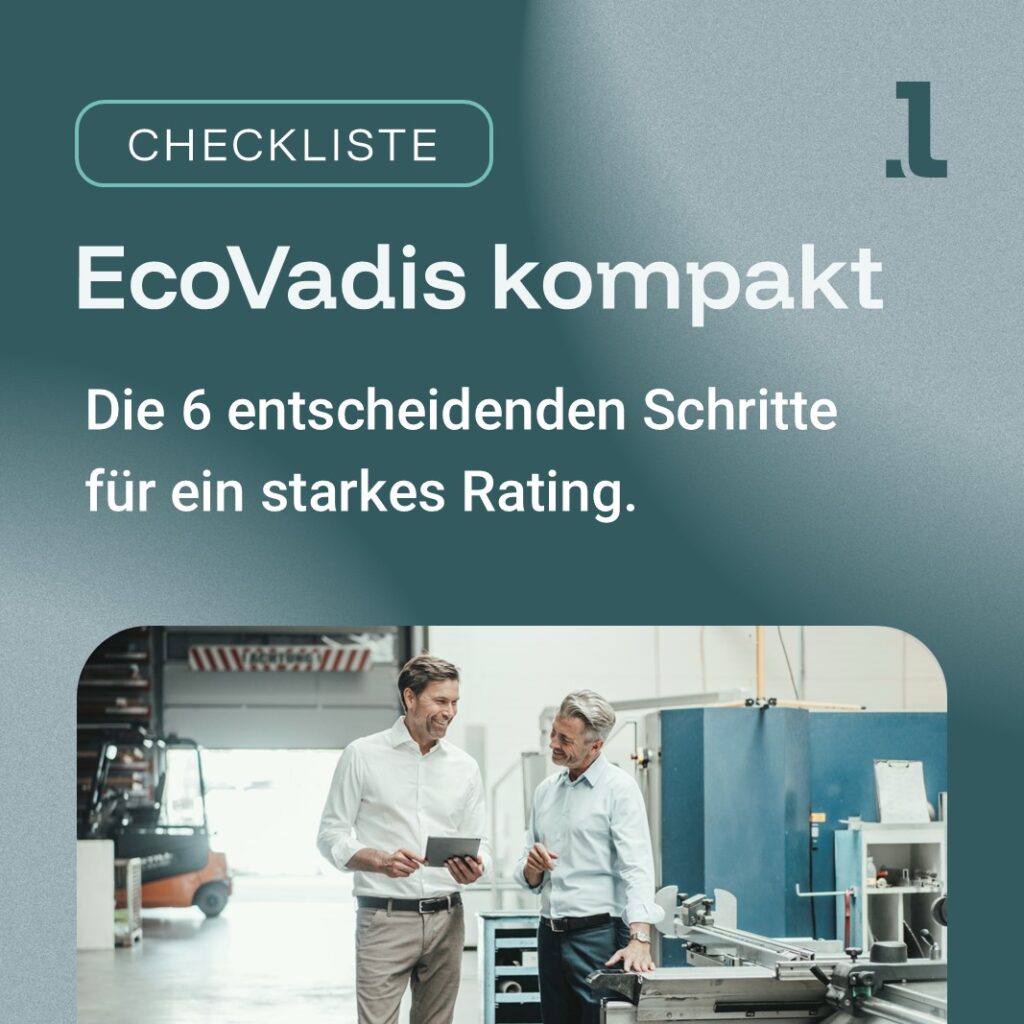
In this checklist, you will learn:
-
How EcoVadis assesses companies and the logic behind its scoring system
-
Which areas carry the most weight in EcoVadis assessments
-
How to make the best use of existing documents across multiple questions
-
What EcoVadis formally requires from your supporting evidence
-
How digital tools help make the preparation process efficient, transparent, and audit-ready
Der Artikel hat Ihnen weitergeholfen?
Teilen Sie ihn mit Ihrem Netzwerk per LinkedIn, E-Mail oder Whatsapp!