SBTi software that gives you the advantage right away – not only on the fifth attempt.
-
Set targets that SBTi approves the first time
-
Tackle decarbonisation where it delivers the greatest impact
-
Keep track of progress and communicate it with legal confidence
leadity. lead with clarity.
Common pitfalls on the path to SBTi
Corporate Carbon Footprint completed – but does it meet the SBTi framework?
The Science Based Targets Initiative (SBTi) gives companies a scientifically grounded framework for reducing emissions in line with the Paris Agreement’s 1.5°C target. For many companies, this is an important point of reference: for customers, investors, and in tenders. What matters, however, is not only a reliable emissions baseline, but also the ability toset short- and long-term climate targets in line with the SBTi criteria, derive effective decarbonisation measures, and systematically manage progress towards those targets.
In practice, it quickly becomes clear: An existing Corporate Carbon Footprint is an important starting point, but not yet a complete foundation for SBTi. Companies are faced with questions such as: Have all methodological and content-related requirements been taken into account? Have Scope 3, system boundaries, primary data, and FLAG been classified correctly? And are the near- and long-term targets set up in a way that makes the submission robust? If something is missing here, the result is often a time-consuming round of refinement — with follow-up questions, delays, and laborious revision loops during the validation process.
Manage SBTi with confidence instead of working overtime
With the right SBTi tool, climate targets become a business advantage – not a rework project
What changes when your SBTi preparation runs in leadity:
-
More confidence before validation – and in target setting. Build a robust foundation for SBTi-compliant short- and long-term targets, and identify early on whether your data, system boundaries, and documentation are solid.
-
Prioritise the measures with the greatest leverage. leadity helps you assess decarbonisation measures systematically and prioritise them based on impact and economic viability.
-
Create the foundation for credible climate communication. Valid footprint data, a consistent methodology, and traceable target pathways provide the robust figures needed for communication that is aligned with EmpCo requirements for customers and consumers.
-
Turn targets into effective action. Plan the right decarbonisation measures in leadity and track implementation. clea AI provides industry-specific recommendations.
-
Keep Scope 3 and FLAG in view together. Relevant categories, land-based emissions, and methodological specifics become visible early and are addressed in a structured way — without laborious rework.
-
Stay one step ahead of new requirements. SBTi and GHG frameworks are kept up to date in leadity, so you can account for changes early and remain methodologically sound even as new requirements emerge.
Find out how robustly your company is positioned for SBTi today – before small gaps turn into major rework.
Step by step to SBTi readiness
How the right software turns SBTi into an actionable roadmap
Your path to science-based targets andconcrete action starts here:
1. Create a robust foundation with your Corporate Carbon Footprint Capture Scope 1, 2, and 3 in a structured way in leadity and use the SBTi tool to build a robust foundation for SBTi. This makes it clear which categories are covered, where gaps remain, and where data quality, completeness, or boundaries still need to be refined.
2. Set SBTi-compliant targets
Based on your emissions data, define short- and long-term climate targets in line with the cross-sector SBTi criteria. leadity helps you apply methodological requirements consistently and build robust target pathways.
3. Prioritise decarbonisation measures and make target achievement plannable Plan the right decarbonisation measures, assess them based on impact and economic viability, and prioritise the biggest levers for reaching your targets. This turns SBTi from a target state into a concrete implementation plan.
4. Track progress and manage with confidenceUse plan-vs-actual comparisons to track whether your company is on course, which measures are delivering results, and where adjustments are needed. At the same time, assumptions, methods, and evidence remain centrally documented — ready for reporting, communication, and validation.

“The clearly defined framework that leadity provides – from sustainability strategy to the Corporate Carbon Footprint – enables us to save a significant amount of time.”
One solution for every climate challenge
From Corporate Carbon Footprint and decarbonisation to FLAG, ISO, and XDC, leadity brings data, evidence, and processes together in one central platform. This allows you to manage diverse climate requirements efficiently, transparently, and without system breaks.


SBTi readiness at a glance: Your checklist for SBTi compliance
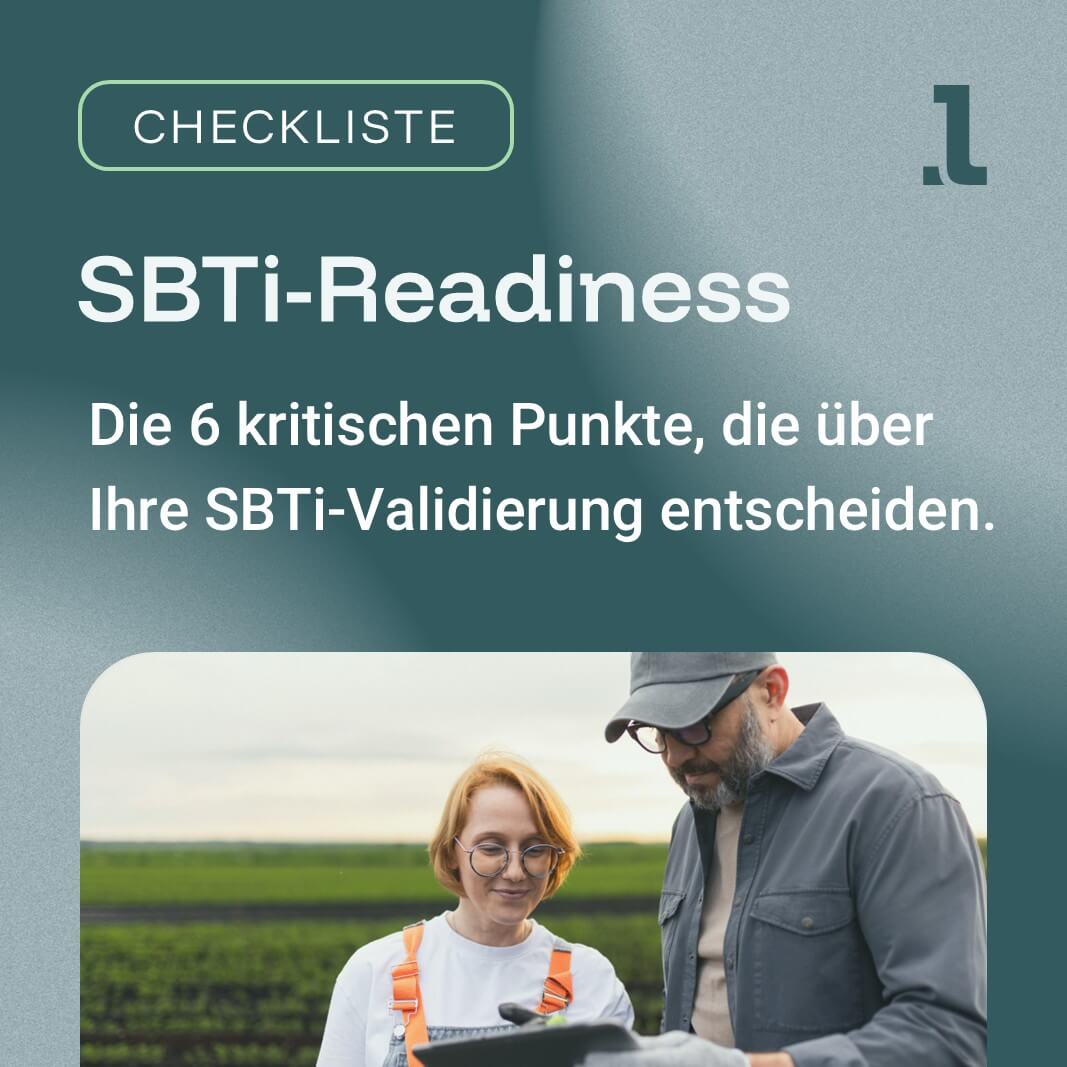
The 6 critical points for your SBTi readiness
Turn science-based targets and FLAG data into a real business lever.
This checklist is right for you if…
-
… you want to assess whether your Corporate Carbon Footprint already meets the core SBTi requirements.
-
… you want to classify Scope 3 and potential FLAG relevance early and correctly.
-
… you need clarity on which data, evidence, and next steps matter now.
Sustainability management with leadity — from mid-market businesses to global players
lead with clarity – with more than 600 companies from over 20 industries in over 50 countries




















SBTi readiness check — clarity instead of guesswork
Free initial consultation: Are you SBTi-ready?
Book a free consultation and review your Corporate Carbon Footprint for SBTi compliance together with leadity’s experts – so you can finally approach science-based targets in a structured way and save valuable time and resources.
leadity AI features at a glance
AI power exactly where ESG & ISO otherwise mean grinding manual work
Our clea AI handles the complexity. You stay in control. Your data stays in Germany. Encrypted, stateless, no third-party training. AI only where it truly makes a difference — we mean it


FAQs on the topic of SBTi
Questions and answers about SBTi with leadity
If you have any further questions, feel free to send them to kontakt@leadity.de
SBTi stands for Science Based Targets initiative. It helps companies define science-based climate targets that are aligned with the 1.5°C goal of the Paris Agreement. To support this, it provides standards, guidelines and validation processes.
No. Participation in the SBTi is voluntary. Even so, more and more companies are aligning with it because science-based climate targets carry greater credibility with customers, investors and other stakeholders.
SBTi validation confirms that a company’s climate targets are aligned with current scientific findings and contribute to the goals of the Paris Agreement. For companies, this is above all a strong external signal: their climate targets are not only defined internally, but also classified in a way that is transparent and understandable from the outside.
Yes. Especially for small and medium-sized enterprises, SBTi can be a helpful framework for setting climate targets on a sound and credible basis. To support this, SBTi offers a dedicated target-setting programme for SMEs. Short-term Scope 3 targets are not mandatory there, but companies still need to measure and reduce their Scope 3 emissions.
A carbon footprint shows how many emissions are generated today. SBTi goes one step further: It gives companies a science-based framework for deriving concrete and validatable reduction targets from that baseline. In short: The carbon footprint is the foundation – SBTi turns it into a target pathway.