ISO audits that become a routine. Not a source of stress.
-
Up to 40% time savings – centralised evidence instead of duplicated effort
-
Integrated audits: Audit multiple standards together.
-
Audit-ready compliance – stress-free audits, reduced risk
leadity. lead with clarity.
The most common ISO pitfalls in mid-market businesses
ISO chaos is not inevitable. It is a system problem.
Whether it’s one ISO standard or several, the pattern is always the same: documents are scattered, evidence is maintained manually, and every audit preparation starts the search from scratch. The more standards you add, the worse it gets: ISO 9001 here, ISO 14001 there, ISO 45001 somewhere else. The same data gets captured multiple times. No one knows which version is current. And internal audits often remain a patchwork, too.
No wonder your day-to-day looks like this: countless spreadsheets, long email chains, and the usual business on top of it all. No sooner is one audit done than the next one is already on the horizon — yet routine, and real, continuous improvement, just never seem to set in.

This costs time and makes it harder to keep an overview:
-
Which evidence belongs to which standard clause?
-
Which areas and processes do you need to audit next?
-
Who is handling which finding, and by when?
-
How do you know that an action is actually working?
Without answers, the outcome is clear: you spend more time searching and preparing for audits than actually improving anything. But with the right system, ISO becomes routine — and a competitive advantage.
Make ISO audits your routine
System over stress. Clarity over chaos.
leadity guides you through ISO requirements, evidence, and internal audits – from planning to effective action. You manage multiple standards in one system and review shared requirements in an integrated way. AI-supported, automated, and cross-departmental.
Your path to a stress-free ISO routine starts here:
-
Structured implementation: All ISO requirements mapped in a structured way — with guided gap analysis and clear documentation. Audit preparation becomes plannable rather than stressful.
-
Integrated audits: Audit multiple standards together: elements such as interested parties, risks & opportunities, or environmental aspects are captured once — and used across the board.
-
Tailored internal audits: Plan standalone or integrated audits, define areas and responsible parties, and work with customised questionnaires.
-
Findings that make a difference: Record deviations directly, assign actions and deadlines, and track everything through to proof of effectiveness for real improvement.
-
Simplify management review: leadity automatically generates dashboards and analyses for your management review — so manual data gathering soon becomes a thing of the past.
-
Centralised evidence management: All documents, KPIs, and evidence in one place — accessible at any time and audit-ready. Our clea AI links them to the relevant requirements.
-
Leverage synergies with ESG: Don’t start from scratch — use ESG data (energy, waste, incidents, CO₂) for ISO evidence, and vice versa. Captured once, used many times.
-
Greater internal buy-in:Shared goals and cross-departmental collaboration between HSEQ and ESG teams drive focus, acceptance, and efficient implementation.
ISO thinks like leadity. leadity thinks like ISO.
Why do ISO and leadity match so perfectly?
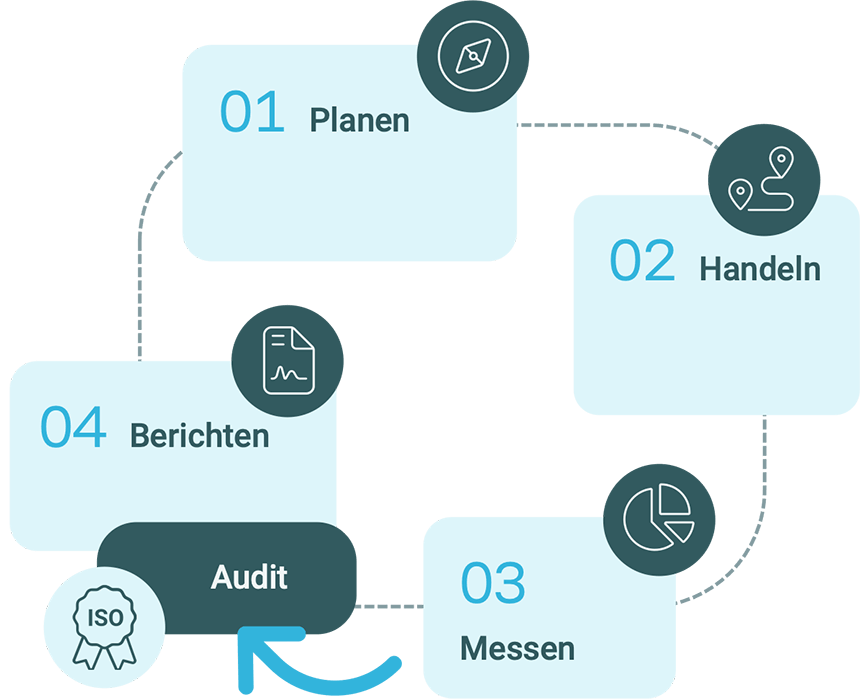
ISO management systems are based on the PDCA cycle (Plan–Do–Check–Act), an iterative management model for continuous improvement. It describes a cycle of planning, implementation, review, and adjustment — with the goal of systematically and sustainably optimising processes.
leadity is built on exactly this principle: Plan your ISO processes centrally, Do with guided workflows, Check through automated validation and monitoring, Act with data-driven improvement measures.
The result: A system that is not only ISO-compliant — but implements ISO the way it was intended. Structured. Transparent. Continuously improving.
ISO management that takes work off your hands
leadity adapts to your existing ISO setup — and helps you get more out of it
Whether you already manage multiple ISO standards (9001, 14001, 45001, 50001) in an integrated way or are just starting out with a single standard: leadity guides you through the process — for internal and external audits alike — and transforms fragmented ISO systems into a centralised management layer.




ISO & ESG management with leadity — from mid-market businesses to global players
lead with clarity – with more than 600 companies across more than 40 industries in over 50 countries



Report once, benefit twice
How much potential are you leaving on the table?
Find out now where you can eliminate duplicated effort — and how leadity helps you reclaim time for what truly matters, instead of constantly chasing data or spending more time reporting than actually making an impact.
leadity AI features at a glance
AI power exactly where ESG & ISO otherwise mean grinding manual work
Our clea AI handles the complexity. You stay in control. Your data stays in Germany. Encrypted, stateless, no third-party training. AI only where it truly makes a difference — we mean it


FAQs on the topic of ISO
Questions and answers about ISO with leadity
If you have any questions, feel free to send them to kontakt@leadity.de
leadity covers common ISO management systems, including: ISO 9001 (quality), ISO 14001 (environment), ISO 45001 (occupational health and safety), and ISO 50001 (energy). We leverage the shared structures of the Harmonized Structure to maximise synergies across standards.
Instead of auditing each standard separately, shared elements (e.g. risk management, document control) are audited just once. leadity ensures that all evidence is centrally available and fully traceable — for faster, more efficient audits.
Yes. Existing documents, evidence, and KPIs can be imported into leadity via upload. Our clea AI automatically assigns them to the relevant ISO requirements.
Every ISO standard contains specific requirements — all of which are stored in leadity. For each requirement, you can upload and link the relevant evidence. An overview shows at any time how many requirements already have evidence in place — and where action is still needed. This way, you are fully prepared for your audit before the auditors arrive.
Yes — significantly so. Instead of documenting and maintaining processes multiple times, you do it once and do it right. Companies report up to 40% less time spent on audit preparation.
Absolutely. Mid-market businesses in particular often lack the resources for complex management systems. leadity makes ISO compliance achievable even with small teams — through automation, templates, and guided processes.
leadity meets the highest security standards (ISO 27001, GDPR-compliant, hosted in Germany). Your data is encrypted, audit-proof, and accessible at all times.
Absolutely — leadity is not only designed for companies managing multiple management systems. Even if you are certified — or pursuing certification — under a single standard such as ISO 9001, ISO 14001, or ISO 27001, you benefit from day one.