PPWR software: Compliance confidence under the new regulation
-
Identify compliance risks early — before they become costly
-
Cut documentation effort in half — centralised instead of scattered
-
Make PPWR manageable — without rebuilding your processes
leadity. lead with clarity.
Why PPWR is becoming a risk for many companies right now
PPWR becomes a compliance risk where structure is missing
Under PPWR, it is no longer enough to manage individual packaging items operationally. What matters is whether your entire packaging portfolio can be assessed, documented, and backed by reliable evidence in the event of an audit.
The real challenge of the PPWR is not the individual requirements. It is whether packaging data, supplier evidence, and technical documentation are structured in a way that allows compliance to be clearly demonstrated at any time. What is often scattered today across spreadsheets, PDFs, emails, or individual departments becomes a risk under the PPWR. Packaging compliance therefore becomes a data-driven, audit-ready management issue.

Where PPWR creates pressure in practice:
-
Rising compliance risk: Anything that cannot be backed by reliable evidence becomes a compliance issue.
-
Higher documentation effort: Data, evidence, and PPWR documentation must be consolidated, maintained, and ready to present at any time.
-
More complexity in day-to-day operations: More teams involved, more coordination, more potential for errors.
Without a clear structure, packaging compliance quickly becomes a predictable risk. This is where PPWR software makes the difference.
From PPWR risk to reliable implementation
From PPWR complexity to manageable packaging compliance
leadity creates the foundation for centrally managing packaging data, evidence, and PPWR documentation — and for embedding PPWR efficiently into existing processes.
This is how you benefit from a structured PPWR implementation:
-
Keep relevant obligations clearly in view: Instead of working through individual requirements one by one, you can see at a glance which PPWR requirements are relevant for which packaging — and where action is needed.
-
Compliance reliably safeguarded: Technical documentation and declarations of conformity can be created in a structured way, stored centrally, and easily demonstrated in the event of an audit.
-
Significantly reduce manual effort: Packaging data, supplier evidence, and documents are brought together centrally in your PPWR software — instead of remaining scattered across files, inboxes, and departments.
-
Keep pace with regulatory change: As regulatory requirements continue to evolve, PPWR remains manageable for your company and under control in day-to-day operations.
Step by step to manageable PPWR implementation in your company
This is how you create the foundation for PPWR compliance
The path to reliable PPWR implementation in companies does not begin with even more files, but with clear structures for data, evidence, and documentation.
1. Bring packaging and material data together centrally
Create a reliable data foundation for your entire packaging portfolio. When packaging and material data is centrally available in PPWR software, requirements no longer need to be checked only one by one, but can be managed in a structured way across products, markets, and packaging types.
2. Assign evidence and documents to specific packaging
Supplier documents, certificates, and declarations of conformity are assigned directly to the respective packaging. This creates a clear and traceable evidence structure.
3. Create technical documentation and DoC for PPWR
Erstellen Sie technische Dokumentationen für verschiedene PPWR-Anforderungen sowie Declarations of Conformity (DoC) gemäß PPWR. So lassen sich Konformitätserklärung und Nachweisführung strukturiert und belastbar aufsetzen.
4. Integrate packaging data into existing systems and processes
Take over relevant data from existing systems and embed PPWR into your current processes — with the help of your packaging compliance software. With central PPWR software, packaging compliance does not remain a one-off project, but becomes part of day-to-day operations.

“If you are losing track of all the ESG obligations, there is no need to feel guilty — you need a good tool. There is no right or wrong. Just get started, even with small steps, and do not be afraid of change. leadity can take that fear away — and provide structure.”
Sustainability management with leadity — from mid-market businesses to global players
lead with clarity — with more than 600 companies from over 40 industries in over 50 countries

















PPWR: What applies now – your 7-day roadmap for the most important obligations from 12 August onward
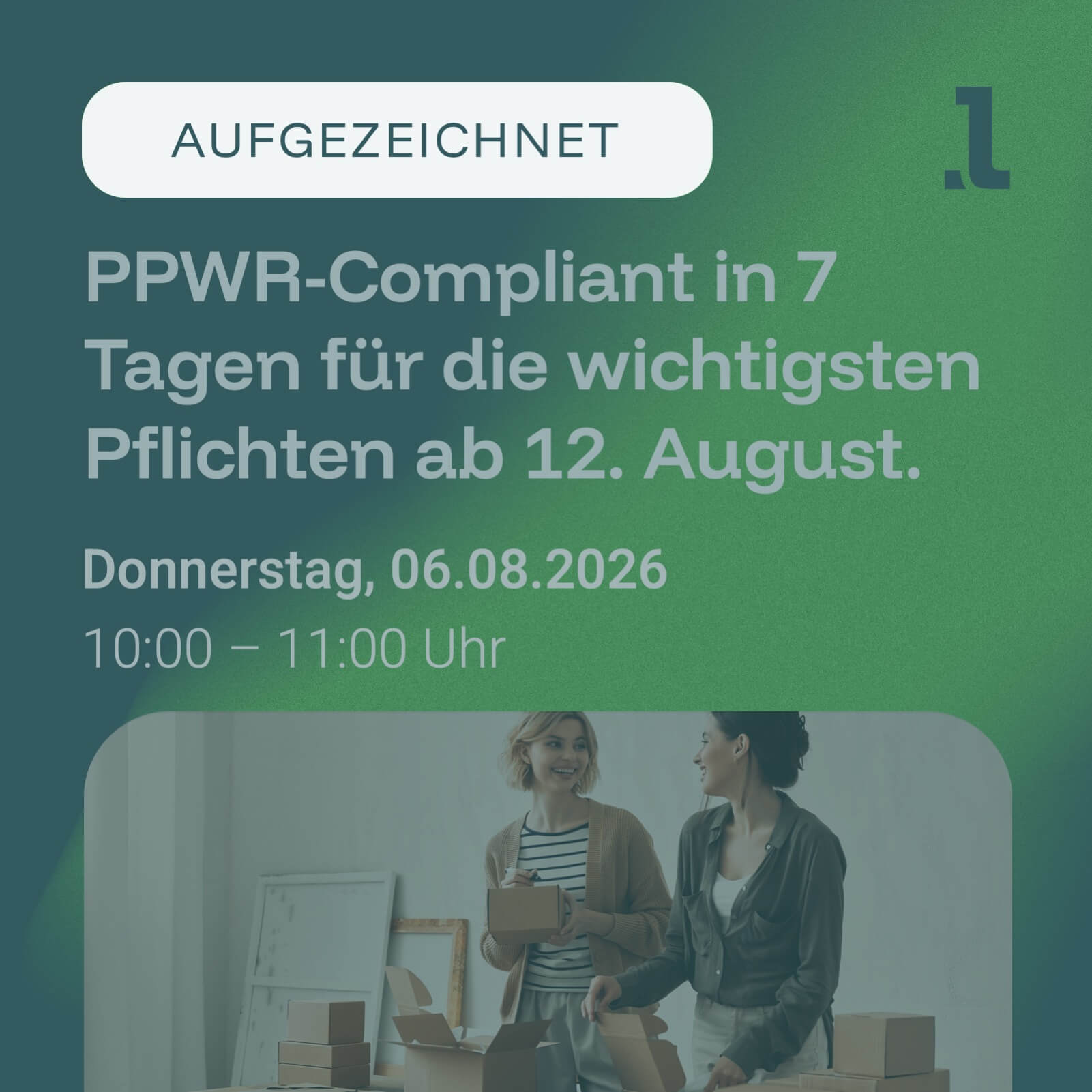
PPWR-compliant: Your 7-day roadmap to PPWR
How to prepare for the PPWR now.
In this webinar recording you will learn:
-
Which requirements become immediately relevant from 12 August
-
Whether you are classified as a manufacturer, distributor, or importer — and what that means for your requirements
-
How to prepare for requests in a structured way
Less uncertainty. More control.
Your free PPWR consultation for packaging compliance
Learn how to manage packaging data, evidence, and technical documentation in a structured way — and embed PPWR into your existing processes. Secure your free initial PPWR consultation with our leadity experts now.
leadity AI features at a glance
AI power exactly where ESG & ISO otherwise mean grinding manual work
Our clea AI handles the complexity. You stay in control. Your data stays in Germany. Encrypted, stateless, no third-party training. AI only where it truly makes a difference — we mean it


FAQs on the topic of PPWR
Questions and answers about PPWR with leadity
Should you have any questions, please feel free to send them to kontakt@leadity.de
leadity’s PPWR software consolidates packaging data, supplier documentation, and technical documentation in one place. You can see which requirements apply to your packaging, where gaps exist, and what actions need to be taken. This allows you to manage PPWR compliance in a structured and traceable manner.
The PPWR software is suitable for companies with complex packaging portfolios, multiple markets, or numerous supplier records. Among others, it supports companies in the consumer goods, food, beverage, cosmetics, retail, e-commerce, and manufacturing industries. What matters is not the industry, but the scope of your packaging compliance.
leadity centrally consolidates relevant packaging and material data. This allows you to evaluate your entire packaging portfolio across products, markets, and packaging types. Relevant PPWR requirements and outstanding action items become apparent more quickly.
You assign supplier documents, certificates, and declarations of conformity directly to the respective packaging. This ensures that supporting documentation remains easy to find, up-to-date, and traceable in the event of an audit. This reduces the need to search through Excel files, PDFs, emails, and individual departments.
Under PPWR, packaging data, supporting documentation, and technical documentation must be organized in a structured manner and available in a reliable format in the event of an audit. If this information is scattered across spreadsheets, PDFs, emails, and Teams, the risk of gaps and errors increases. leadity consolidates the relevant information and provides visibility into the implementation status.
Yes, leadity integrates relevant data from existing systems and workflows. This means you don’t have to redesign your processes; instead, you can integrate packaging compliance step by step. PPWR thus becomes part of your day-to-day operations rather than an additional standalone project.
The price for leadity’s PPWR software is always determined on a case-by-case basis during the process. To do this, the needs and circumstances of each individual customer are factored into the calculation.