
EmpCo Directive: What mid-market businesses need to know now
The EmpCo Directive requires companies to make environmental and sustainability claims more transparent and verifiable. Going forward, sustainability promises must be backed by evidence. Inaccurate or misleading claims can quickly become expensive. Find out how to take the right precautions now.
12 February 2026
4-minute read
What is the EmpCo Directive?
The EmpCo Directive (EU) 2024/825 is an EU directive designed to prevent greenwashing and protect consumers from misleading environmental and sustainability claims. EmpCo (Empowering Consumers for the Green Transition) requires companies to avoid vague environmental promises such as “climate neutral” or “sustainable” and to use specific claims instead. These must be backed by concrete evidence presented directly on the product.
The EmpCo Directive complements the Unfair Commercial Practices Directive (UCPD) and will apply across the EU from 27 September 2026. Companies still have time to prepare.
EmpCo and Green Claims: What is the difference?
While the Green Claims Directive has attracted a lot of public attention, EmpCo tends to fly under the radar. One reason might be that the Green Claims Directive sets out very extensive obligations for companies, so the significance of EmpCo has been underestimated so far.
The Green Claims Directive was intended to set out very detailed requirements for substantiating environmental claims, for example through independent verification and certification. For now, however, the legislative process for the Green Claims Directive is on hold. The concern is that it would place an excessive bureaucratic burden on companies. It remains unclear whether the process will resume.
Important: The EmpCo Directive has already been adopted and is being transposed into national law across the EU.
EmpCo: These requirements must be met
The EmpCo Directive is implemented within the framework of the EU Unfair Commercial Practices Directive (UCPD).
-
One of the key requirements of EmpCo is that claims about future environmental performance must be based on a publicly available, realistic implementation plan that sets out how these commitments and targets will be achieved. In other words, the targets have to be realistic and measurable. In addition, the directive requires them to be monitored regularly by an external expert.
-
Also, environmental claims will only be permitted in future if they are specific. For example, a phrase such as “climate-friendly packaging” would be too general. “100 percent of the energy used to produce this packaging comes from renewable sources,” on the other hand, is specific.
-
In addition, generic environmental claims such as “climate neutral,” “environmentally friendly,” “green,” or “biodegradable” will be prohibited in future, unless they are backed by meaningful evidence. The legislator refers to a demonstrable “recognised, excellent environmental performance.” This points to regulated frameworks that define specific environmental performance levels and criteria. One example is energy and consumption labelling, where devices are certified with particular energy classes. So far, however, such frameworks are very rare in the EU.
-
Sustainability labels will only be permitted from September 2026 if they are established by public authorities or based on a certification scheme that is monitored by third parties.
What is important when implementing the EmpCo Directive?
Sustainability managers should now review the environmental and sustainability claims made by their company. These include advertising content, packaging information, and website content, among others. Important: EmpCo also applies to environmental and sustainability claims for existing products and services. It should also be noted that even as a mere distributor of products, you are responsible for the environmental claims on those products.
At company level, on the other hand, environmental claims are still allowed, as long as they are not misleading and do not breach the Act against Unfair Competition (UWG). For example, it remains possible to state that a company is on track to become climate neutral by 2045 – provided that specific implementation plans for these targets are in place.
For a long time, it was unclear how the EmpCo requirements should be implemented. For example, the initial German draft law provided that a QR code on the product would be sufficient to direct consumers to a website with the details behind the sustainability claims.
Instead, environmental claims must be sufficiently substantiated with facts in the same medium. This applies not only to product packaging but also, for example, to websites. So far, it is not entirely clear when an environmental claim is considered specific enough.
The question “Does EmpCo apply to all companies or only to B2C communication?” can be answered clearly: The EmpCo Directive applies to communications with consumers and is therefore relevant to B2C communications.
How EmpCo is implemented in the EU
Across the EU, the EmpCo Directive is implemented through amendments to national unfair competition and consumer protection laws. The directive was adopted at EU level and will apply from 27 September 2026.
In Germany, for example, the implementing legislation defines terms such as “environmental claim” and “sustainability label”. Companies must substantiate the basis for their environmental claims. It is particularly important that the repairability, durability, and transparency of a product’s environmental aspects receive greater attention.
What can result from violating EmpCo?
The EmpCo Directive itself does not set fixed fines. In Germany, for example, the directive is implemented through the Act Against Unfair Competition (UWG), meaning that breaches can result in significant costs and consequences. In serious cases, fines of up to four percent of annual turnover may be imposed. Revenue generated through unlawful advertising could be confiscated by the authorities, or access to markets could be restricted. Warnings from competitors or consumer protection organisations are also possible. Regardless of the financial costs of potential fines, reputational damage can result in follow-on costs that are far more substantial than a single penalty.
Conclusion: EmpCo is more than “just another regulation”
The EmpCo Directive requires companies to be more transparent and honest in their sustainability communications. This helps strengthen the sustainability sector as a whole.
The EmpCo rules are therefore far more than an additional bureaucratic requirement: The directive creates a level playing field for all market participants. This protects companies that genuinely invest in sustainable products from unfair competition caused by greenwashing.
The good news is: The EmpCo Directive can open up new opportunities.
Companies that act now can prevent fines and legal action. By implementing the EmpCo Directive, they can strengthen trust among customers and business partners, reinforce their brand image, and gain a clear competitive advantage. The key is to substantiate environmental and sustainability claims with concrete evidence and adapt future wording processes accordingly.
leadity supports you with one central platform — from developing sustainability strategies to generating reports. Standards and certifications can help your company stand out. The platform integrates not only ZNU certification, but also other trusted frameworks such as GRI, DNK, and the SDGs.

EmpCo and ESG: How companies can make credible and legally sound claims
With the new EmpCo Directive, the substance behind claims about environmental, social and governance responsibility is becoming a central focus of regulatory scrutiny. How can mid-market businesses establish credible and compliant communications on these issues?
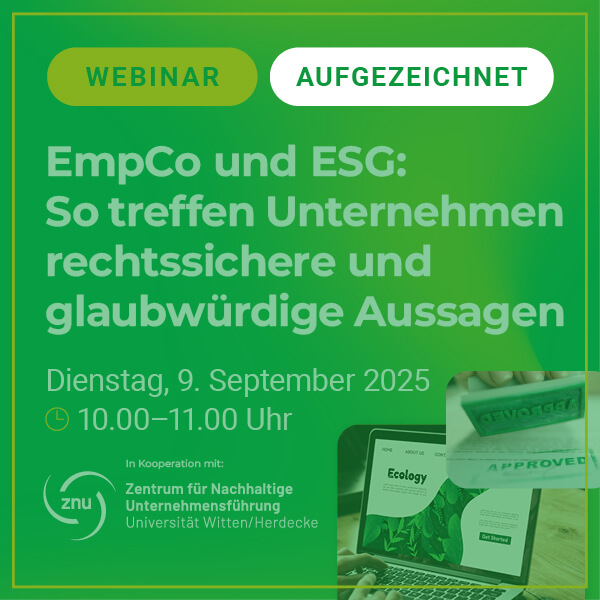
In our webinar recording, you will learn:
-
How the EmpCo Directive is positioned within the EU regulatory framework and what it means for your communications on these issues
-
What pitfalls do terms such as “ecological” or “environmentally friendly” present, and how can you avoid them?
-
How agencies and companies are already working together to create brand-strengthening, EmpCo-compliant communications
-
How leadity helps you build a robust, data-driven foundation for your sustainability claims — systematically and efficiently
You enjoyed reading our article?
Share it with your network via LinkedIn, email or WhatsApp!
More expert articles from our magazine

Internal audits: process, goals and preparation at a glance
Internal audits show whether management systems actually work in day-to-day practice. With clear audit criteria, independent auditors and structured follow-up, you can identify risks, address deviations and improve processes. This overview explains the process, goals, audit types and specific questions for reliable audit practice in your company.

ISO 50001 – Definition, requirements and certification
ISO 50001 is more than a certificate. Systematic energy management improves energy efficiency, reduces energy consumption and costs, and establishes clear responsibilities. Learn how to systematically record energy use and KPIs, centralise evidence, and position your company to be energy-efficient, audit-ready and future-ready.

ISO 14001 – Definition, requirements and certification
ISO 14001 helps organisations manage environmental aspects systematically, reduce environmental impacts and continuously improve their environmental performance. Learn about the requirements of the standard, the benefits of certification and how to implement environmental management in a structured way – including with software.