ISO 27001 – Definition, requirements and certification
ISO 27001 is the international standard that helps companies manage information security systematically. That is why it matters to companies seeking to address data breaches, cyberattacks and system outages strategically, not just technically. Information security is no longer just an IT issue — it is a matter of corporate governance. Find out what the standard requires, what certification can offer and what the process involves.
24 June 2026
5-minute read
Whether it is supplier requests, regulatory obligations or the protection of sensitive customer data, information security requirements are increasing across almost every industry. Many companies respond with individual measures: a new firewall here, a password policy there. What is often missing is a systematic framework to identify and assess risks as a whole and keep them under control over time. That is what ISO 27001 provides: an internationally recognised standard for information security management systems.
What is ISO 27001 — explained simply
ISO 27001 is the key standard for how companies should handle sensitive data and digital risks.
The international standard sets out the requirements for establishing, implementing, operating and continually improving an information security management system — or ISMS. An ISMS is a structured framework of policies, processes and measures that ensures information is protected systematically across the company.
To understand what ISO 27001 covers, it helps to start with three terms that are often confused: information security, cybersecurity and data protection.
Information security, cybersecurity and data protection – what is the difference?
-
Information security is the umbrella term. It protects information in any form: digital, on paper or spoken. Its objectives are to preserve the confidentiality, integrity and availability of data.
-
Cybersecurity is one part of information security. It focuses specifically on protecting digital systems and networks from external attacks.
-
Data protection governs the handling of personal data. In Europe, this is primarily regulated by the GDPR (General Data Protection Regulation). A well-designed ISMS provides many of the technical and organisational measures also required for data protection.
ISO 27001 applies to companies of every size and across all industries – from dairy businesses to mechanical manufacturers, and from mid-market businesses to large corporations. The standard deliberately avoids a rigid list of measures. Instead, it provides a framework each organisation can tailor to its own risk profile.
What are the ISO 27001 requirements?
ISO 27001 follows the so-called Harmonized Structure. This requires different ISO standards to follow the same structure and use the same core terms. Other ISO management standards, such as ISO 9001 and ISO 14001, use the same underlying structure. This makes it much easier to integrate multiple standards.
The standard is divided into ten main clauses. The actual ISMS requirements are set out in Clauses 4 to 10. Companies must address each of these clauses to demonstrate conformity with ISO 27001.
The core areas at a glance — Clauses 4 to 10
-
Context & leadership (Clauses 4–5): Before establishing an ISMS, a company needs to understand its own context. It must identify the internal and external issues that affect information security, as well as the requirements set by customers or authorities. Senior management must set an information security policy, assign responsibilities and actively integrate the ISMS into the company’s strategy.
-
Planning & risk management (Clause 6): Structured risk assessment is at the heart of the standard. The company identifies and assesses information security risks, then decides how to address them through technical measures, organisational controls or documented risk acceptance.
-
Operation & support (Clauses 7–8): An ISMS needs resources such as qualified employees, company-wide information security awareness and complete documentation. Processes are implemented in day-to-day operations, reviewed regularly and adjusted as needed.
-
Evaluation & improvement (Clauses 9–10): Internal audits and regular management reviews help ensure that the ISMS remains effective. Deviations are analysed and corrected in line with the PDCA cycle (Plan–Do–Check–Act), which underpins the entire standard.
Why is ISO 27001 relevant to companies?
For many companies, information security is no longer an optional extra. Pressure is coming from several directions at once. Customers and business partners increasingly ask how their data is protected. In B2B settings in particular, ISO 27001 certification is often a prerequisite for being added to supplier lists or taking part in tenders. There are also regulatory requirements, such as the EU NIS2 Directive, which introduces binding cybersecurity and incident management obligations for many companies. Cyber insurers are also increasingly requiring evidence of basic security standards.
At the same time, operational risk is growing. Cyberattacks are now among the most common causes of serious business disruption. Mid-market businesses are particularly exposed: they are often less well protected than large corporations, while still offering attackers attractive targets. ISO 27001 addresses these risks not through isolated technical measures, but through a systematic management system that identifies, assesses and continuously manages risks.
What benefits does ISO 27001 offer companies?
From the outside, ISO 27001 is often seen as a certificate needed for customers or tenders. But its real value lies within the company.
-
Clarity about risks and responsibilities:
An ISMS requires companies to map their information landscape systematically. What data do we hold? Who has access? What happens if something fails or is compromised? Many organisations lack this clarity, leaving them exposed. ISO 27001 provides a reliable foundation. -
Structured processes instead of ad hoc responses:
Without an ISMS, companies often respond to security incidents too slowly and without coordination. ISO 27001 establishes incident management and contingency planning processes before an incident occurs. -
Competitive advantage and trust:
An ISO 27001 certificate provides independent evidence that information security is taken seriously by a company in its dealings with customers, banks and authorities. Companies that have the certificate while others are still considering it gain a clear advantage.
The path to certification
ISO 27001 certification is not a one-off project. It is a structured process that can be planned effectively.
This checklist shows which seven ISO clauses determine your certification and how to use existing evidence to close gaps systematically and prepare for your audit.
The general ISO certification process follows these steps:
Scope & risk analysis: The first step is to define which parts of the company the ISMS will cover. The company then identifies information assets, analyses threats and vulnerabilities, and assesses risks. The result is a prioritised overview of where action is needed.
Implementing measures: Based on the risk assessment, the company selects measures from normative Annex A of the standard. The Statement of Applicability (SoA) documents which controls apply and which do not.
Internal audit & certification audit: Before an accredited certification body — such as TÜV, DQS or DEKRA — conducts the external audit, the company checks whether its ISMS meets the requirements through an internal audit. The certificate is valid for three years and requires annual surveillance audits. In Germany, certification based on IT-Grundschutz is also possible. In this case, the assessment is carried out by an auditor certified by the BSI.
The timeline depends on where the company is starting from. Companies that already operate other ISO standards can often achieve certification within six to twelve months. Those starting from scratch should plan for around twelve to eighteen months.
What does ISO 27001 certification cost?
There is no single fixed price for ISO 27001 certification. Costs vary considerably depending on the scope, documentation requirements and resources needed.
In practice, four key factors have the greatest impact on costs:
| Cost factors | What does it involve? |
| 1. Scope | The scope defines which locations, processes, systems and interfaces the ISMS covers. |
| 2. Documentation & process complexity | Documents, approvals and evidence must be structured and kept up to date. The more complex the processes, the greater the implementation effort. |
| 3. Resources & expertise | The ISMS requires time, clear responsibilities and the right expertise. Limited capacity increases the workload. |
| 4. Audit and operational effort | Internal audits, management reviews and evidence are required regularly. Well-established routines make the workload more predictable. |
A closer look at the four key factors:
1. Scope:
The scope defines which parts of your company the ISMS covers and which will later be certified. Costs are driven mainly by a very broad scope — more locations, processes and systems — and by numerous interfaces, for example when critical services are outsourced or multiple business units work together. These dependencies must be accounted for and managed within the ISMS, with clear responsibilities and traceable evidence. The guiding principle is: as broad as necessary, as clearly defined as possible — this reduces coordination and audit effort.
2. Documentation & process complexity:
ISO 27001 requires “documented information”. Exactly what is needed, and how much, depends largely on your organisation. Costs rise when documents are scattered, versions are unclear or processes exist only in people’s heads. The extra work then comes not from the standard itself, but from rework: updating policies, arranging approvals and gathering evidence from emails and folders. The better your documents are structured, maintained and easy to find, the faster implementation will be — and the smoother the audit.
3. Resources & expertise:
An ISMS depends on people, not paperwork. The standard requires organisations to provide resources and ensure that people have the necessary competence. The main cost drivers are not usually a lack of knowledge, but limited capacity and unclear responsibilities. When information security is treated as a side task, work gets delayed or only one person knows how to do everything. By contrast, the workload falls considerably when roles are clearly assigned, management provides support and employees know what they need to deliver and when.
4. Audit and operational effort:
ISO 27001 is not a one-off project. Internal audits and management reviews must be planned and carried out to keep the ISMS effective. The biggest cost driver is a lack of routine: When evidence, risk assessments or decisions have to be put together from scratch every year, the workload stays high. By documenting continuously and organising evidence properly, you can make each audit a predictable repeat process rather than an annual strain.
When is ISO 27001 software worthwhile?
Many companies start implementing ISO 27001 with the tools they know: spreadsheets to track measures, emails to coordinate work and separate folders for evidence. This may work until the first ISO audit. Then it quickly becomes clear how much time is lost searching for the latest documents, compiling evidence and coordinating across departments.
An ISO software can help: It brings requirements, evidence and responsibilities together in one place, makes implementation progress visible at any time and reduces manual work — especially when preparing for an audit. For companies managing several ISO standards or additional ESG requirements, an integrated solution offers even greater value: data is captured once and reused, rather than maintained in parallel systems.
Recommended article
From ISO to ESG: How to leverage existing structures for sustainable success

ISO management systems offer more than certificates. Connecting them with ESG saves time and costs, increases efficiency and credibility – and makes your organisation future-ready.
Conclusion: Your ISO 27001 software — how leadity supports you
Efficiently implementing ISO 27001 in day-to-day business requires a structured foundation: clear responsibilities, complete documentation and processes that do not have to be rebuilt for every audit.
leadity brings ISO requirements together in one place, with clear responsibilities, configurable user roles and AI-supported links between relevant data. Teams can track implementation progress without having to search for information manually. When an audit is due, evidence and KPIs are already stored and assigned. Auditors receive direct remote access, and AI automatically maps evidence to requirements. The result: less preparation and more routine.
Companies operating several standards can use ISO 27001 in leadity together with up to two additional ISO standards. Common elements such as risk management and document control are recorded once and used across all standards. Companies already managing ESG data in leadity can use it directly as ISO evidence — and vice versa.

ISO clarity for mid-market businesses: From standard to business value
Find out how to build and manage ISO effectively in a mid-market business, what the PDCA cycle can do for you and how to use synergies between ISO standards to your advantage.
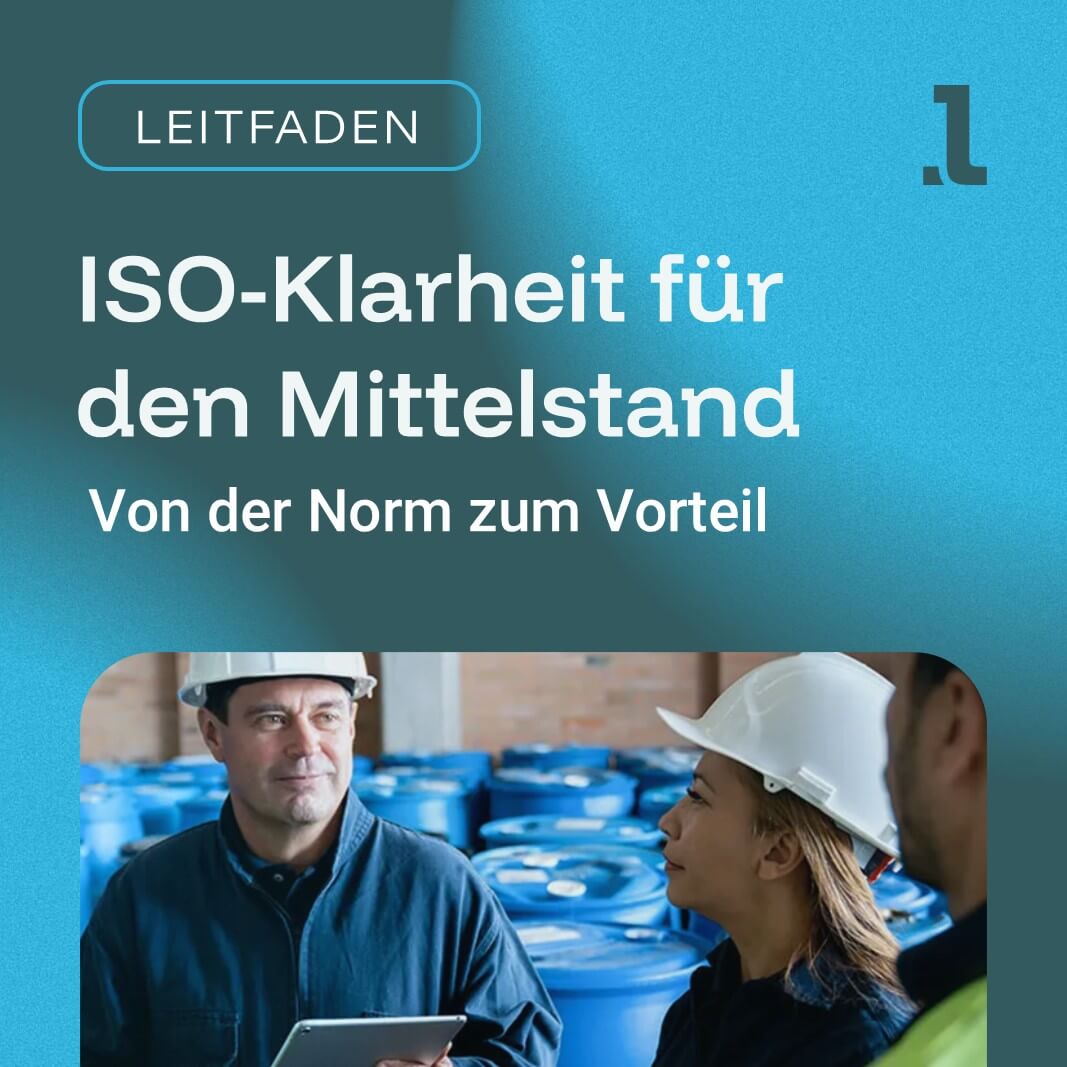
In this guide, you’ll learn:
-
How to turn ISO requirements into an effective management system
-
How to link risks, actions and KPIs using the PDCA cycle
-
How to leverage multiple ISO standards and ESG together while avoiding duplicate work
You enjoyed reading our article?
Share it with your network via LinkedIn, email or WhatsApp!
More expert articles from our magazine
FAQs about ISO 27001
Questions and answers about ISO 27001
If you have any questions about ISO, ESG strategy, management or reporting in leadity, please email us at kontakt@leadity.de
ISO 27001 is an international standard for information security management systems. It sets requirements for establishing, implementing, operating and continually improving an ISMS. Companies use it to protect their information systematically from risks.
An information security management system, or ISMS, is a structured framework of policies, processes and measures. It defines how a company protects information and manages digital risks, while safeguarding the confidentiality, integrity and availability of data.
No. leadity itself is not an information security management system (ISMS). However, leadity offers features for managing ISO standards and documentation, which can significantly simplify the ISO certification process.
Information security is the umbrella term and protects information whether it is digital, on paper or spoken. Cybersecurity focuses on digital systems and networks. Data protection governs the handling of personal data, while an ISMS provides many of the technical and organisational measures needed to protect it.
Requirements cover areas such as the company’s context, management responsibility, risk assessment, operations, internal audits and improvement. Implementation follows the PDCA cycle: Plan, Do, Check and Act. The requirements are set out in Clauses 4–10 of the standard.
Companies must identify and assess information security risks and define suitable measures. These may include technical measures, organisational controls or documented acceptance of a risk. The measures needed depend on the company’s risk profile.
Customers and business partners increasingly expect clear information about how their data is protected. Tenders, regulatory requirements such as NIS2 and cyber insurance requirements may also call for information security measures. ISO 27001 helps companies manage risks such as data breaches, cyberattacks and system outages systematically.
ISO 27001 provides clarity about information assets, risks and responsibilities. It also establishes structured processes for incident management and contingency planning. The certificate provides independently verified evidence and can strengthen trust among customers, banks and authorities.
First, companies define the scope of the ISMS and conduct a risk analysis. They then select and implement suitable measures and document them. An internal audit is followed by the certification audit carried out by an accredited certification body; the certificate is valid for three years and requires annual surveillance audits.
ISO 27001 is generally not a legal requirement for all companies. In practice, however, certification may be relevant because of customer requirements, tenders, regulatory obligations or cyber insurance. Companies should therefore check which requirements apply in their industry and business relationships.