
PPWR – What companies need to know about the regulation in 2026
The PPWR is the new EU packaging regulation, and it fundamentally changes the requirements for packaging in Europe. For your company, the key is not only to design packaging in a compliant way, but also to keep robust evidence, data, and documentation on hand. In this article, you will learn what the PPWR covers, who is affected, and how you can implement the new requirements in a structured way.
15 July 2026
7-minute read
The pressure to act increases in particular for companies that manage large volumes of packaging, multiple sales regions, or complex supply chains. Under the PPWR, packaging compliance becomes far more data- and evidence-intensive. Anyone who fails to bring packaging data, technical documentation, and responsibilities together in a structured way risks a high level of manual effort, uncertainty in implementation, and avoidable compliance risks. At the same time, the opportunity is clear: With early preparation, processes can be set up more effectively and regulatory requirements managed more efficiently.
What is the PPWR?
PPWR is the new EU Packaging and Packaging Waste Regulation covering packaging and packaging waste. It creates a new European legal framework that reorganises the requirements for packaging and the handling of packaging waste. The regulation officially entered into force on 11 February 2025. Its requirements apply from 12 August 2026.
What does PPWR mean for companies?
The PPWR – the Packaging and Packaging Waste Regulation – significantly expands the requirements for packaging, evidence, and internal processes. Many of its provisions take effect gradually. Companies should therefore build the necessary structures early, even though some regulatory details are still being defined. As a result, packaging compliance is increasingly becoming a data-driven, audit-ready management issue.
What are the goals of PPWR?
PPWR is designed to reduce the environmental impact of packaging and cut the volume of packaging waste. Further goals of the PPWR include making packaging reusable and recyclable, in order to drive the transition to a circular economy.
In 2023, the EU generated nearly 80 million tonnes of packaging waste. Although the amount decreased slightly compared with the previous year, packaging waste remains a significant environmental challenge across Europe. The new regulation aims to reduce this waste by promoting prevention, reuse and recycling.
PPWR – who is affected?
In principle, the PPWR applies to all packaging placed on the market in the EU and to all packaging waste, regardless of the type of packaging or material. This means that packaging manufacturers are not the only ones affected. The regulation addresses a range of economic operators along the supply chain, including producers, manufacturers, importers, distributors, and final distributors.
What matters most for companies: The PPWR covers not only the actual placing of packaging on the market, but also the provision of information and evidence along the supply chain. Article 16, for example, explicitly addresses suppliers’ duty to provide information. Suppliers must pass on key information and documentation to the producer. This is the only way to demonstrate that a packaging item meets the requirements of the PPWR. It becomes clear that packaging compliance does not end at a single point, but relies on robust data and collaboration between several parties.
What are the core elements of PPWR?
The PPWR covers a range of areas, including: recyclability, minimum recycled content, compostability of packaging, packaging minimisation, reusability, labelling requirements, technical documentation and declarations of conformity, reduction of packaging waste, and recycling targets.
The areas in detail:
-
Recyclability: Recyclability is one of the core requirements of the PPWR. As a result, there is greater emphasis on how packaging is assessed in a regulatory context and what data must be available for that purpose.
-
Minimum recycled content: For plastic packaging, the PPWR sets binding minimum shares of recycled material. From 2030, different quotas apply depending on the type of packaging: 30% for certain contact-sensitive PET packaging, 10% for contact-sensitive packaging made from plastics other than PET, and 35% for other plastic packaging. From 2040, these requirements increase further.
-
Compostability of packaging: From 12 February 2028, certain packaging classed as compostable must meet the requirements for industrial composting. This also applies to stickers attached to fruit and vegetables.
-
Packaging minimisation: Packaging minimisation is a further focus of the PPWR. The goal is to reduce the weight and volume of packaging to the essential minimum, without compromising its function. From 2030, specific requirements apply. In principle, packaging that artificially increases its volume will no longer be permitted – for example, through false bottoms, double walls, or unnecessary layers.
-
Reusability: Reusability is also part of the PPWR. From 12 August 2026, packaging is considered reusable only if it can be used multiple times. It must also meet certain requirements for design, hygiene, safety, and recyclability. Reusable packaging must not only work in practice, but also be assessed correctly from a regulatory perspective and integrated into suitable return or reuse systems.
-
Labelling requirements: The PPWR also includes requirements for labelling. This increases the need to capture relevant packaging information in a structured way and provide it transparently. In future, harmonised details on material composition will be required. For certain packaging, additional information on compostability, reusability, or recycled content will apply. In some cases, information will also need to be provided digitally, for example via a QR code.
-
Technical documentation and declarations of conformity: When the new regulation takes effect on 12 August 2026, the key rules on conformity assessment will apply. From that point, companies must be able to document that their packaging meets the requirements of the PPWR and keep the corresponding technical documentation on hand in a structured way.
-
Reduction of packaging waste: The PPWR aims to gradually reduce packaging waste per capita in the EU. Compared with the 2018 baseline year, the following reduction targets apply: at least 5% by 2030, at least 10% by 2035, and at least 15% by 2040.
-
Recycling targets: The PPWR also sets out specific requirements for recycling targets. By 31 December 2025, at least 65% of the weight of all packaging waste must be recycled. By 2030, this target rises to 70%. There are also material-specific quotas, for example 50% for plastics, 70% for glass, 75% for paper and cardboard, and 50% for aluminium by the end of 2025.
What requirements does this create for companies?
Above all, PPWR means more complexity, greater documentation effort, and a rising compliance risk. This is particularly relevant for companies that work with large volumes of packaging, multiple sales regions, complex supply chains, or a high documentation burden.
Packaging compliance therefore becomes a cross-functional topic: data, processes, expert assessment, and evidence management are closely interlinked. Responsibility is often spread across disciplines. This means that it does not lie with management alone, but also with product and packaging development, procurement, and logistics.
Other regulatory contexts show the same pattern. Growing requirements for transparency, evidence management, and supply chain management present companies with new organisational challenges – for example, in connection with the EUDR.
What penalties and risks apply in the event of violations?
Legal risks and sanctions
The PPWR itself does not set fixed fines. Instead, Member States must adopt national penalty rules by 12 February 2027. These penalties must be effective, proportionate, and dissuasive.
Particularly important: For violations of Articles 24 to 29, fines must be part of the sanctions. These articles cover key requirements on the reduction of packaging and packaging waste, such as excessive packaging, prohibited packaging formats, reuse, and refill. The regulation also provides that Member States must apply sanctions in cases of continued non-compliance. For companies, this means that violations can not only be challenged from a regulatory standpoint, but also actively penalised.
Market risks
Beyond sanctions, there are also clear market risks. For companies, this means that violations can not only result in fines, but in the worst case also put market access at risk, force products out of distribution, or disrupt supply chains.
The reason is that the regulation makes it explicitly clear that packaging may be placed on the market only if it meets the defined sustainability and labelling requirements. If non-compliance persists, Member States can take appropriate measures to prohibit its sale or to ensure that the packaging is recalled or withdrawn from circulation.
What are the benefits of implementing PPWR early?
Engaging with the PPWR early can help you structure packaging data, evidence, and processes ahead of time. This creates better conditions for implementing regulatory requirements robustly and reducing internal effort. Especially as physical products are increasingly assessed under other data-intensive frameworks as well, such as the Product Carbon Footprint.
The key benefits for your company are:
-
greater transparency
-
more automation
-
greater certainty in packaging compliance
-
structured and prioritised evidence management
-
early identification of regulatory requirements
-
a reduction in compliance risks and manual effort
How does leadity’s PPWR software support you in putting it into practice?
A PPWR software solution helps you centralise packaging data, manage evidence in a structured way, and implement regulatory requirements more efficiently.
Key relevant features include, in particular:
-
a central packaging database for structured packaging and material data.
-
the creation of technical documentation for various PPWR requirements – for example, on material composition, labelling, or reusability.
-
the creation of declarations of conformity (DoC) in line with PPWR requirements.
-
document and evidence management for supplier documents, certificates, and declarations.
-
the integration of packaging data from existing systems.
This allows you to identify requirements early, organise evidence robustly, and make your packaging portfolios assessable, documentable, and auditable.

PPWR: What applies now – your 7-day roadmap to the key obligations coming into force on 12 August
From 12 August, the PPWR comes into even sharper focus for many companies. In our webinar, you will learn which requirements are now relevant, how to correctly determine your role, and which steps to initiate in the short term to prepare data, evidence, and responsibilities in a structured way.
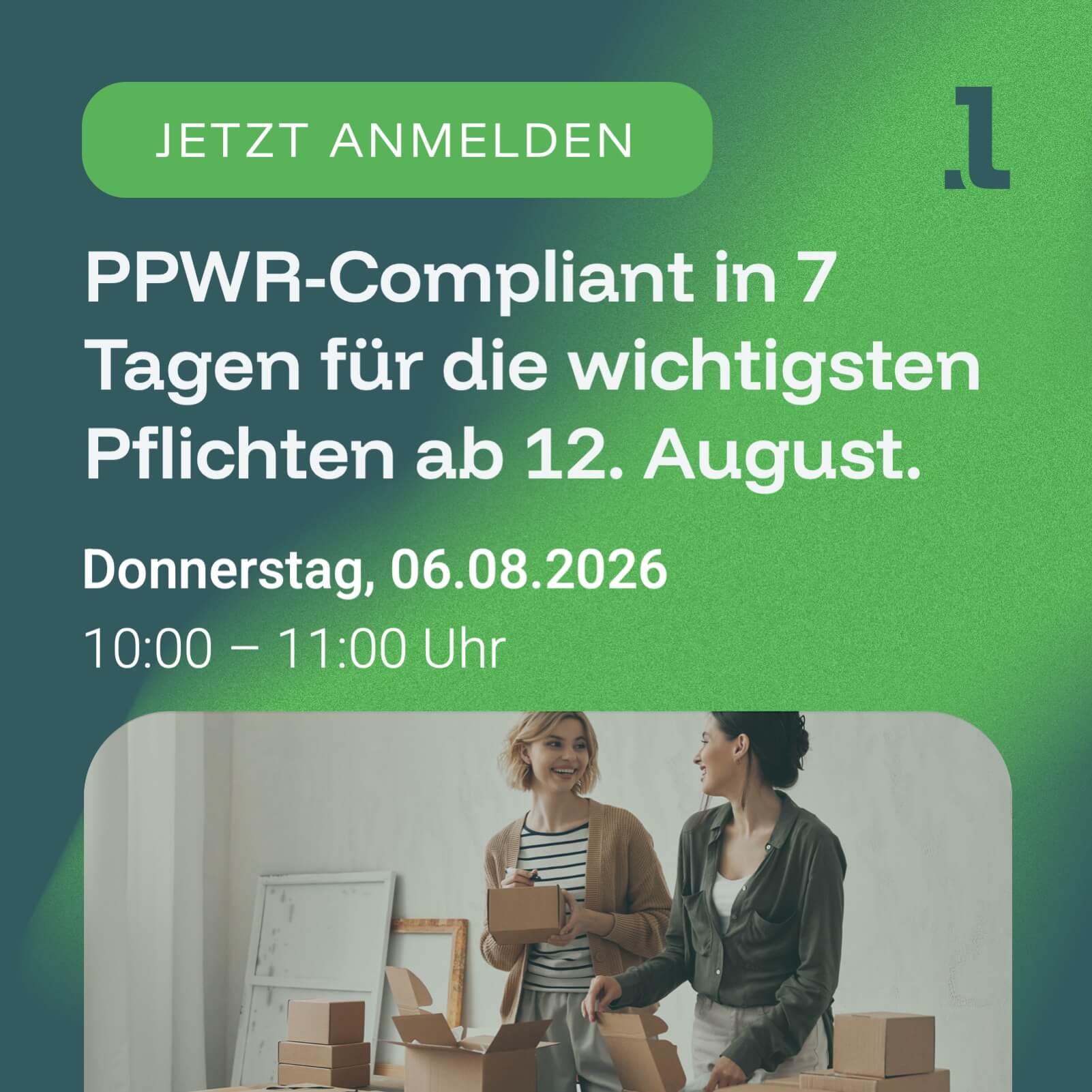
In our webinar recording, you will learn:
-
Which requirements become directly relevant from 12 August
-
Whether you are classified as a manufacturer, distributor, or importer, and what that means for your obligations
-
How to prepare for enquiries in a structured way
You enjoyed reading our article?
Share it with your network via LinkedIn, email or WhatsApp!
More expert articles from our magazine

Product Carbon Footprint – the CO2 footprint of your products
How visible is your products’ climate impact, really? Discover what a Product Carbon Footprint is, how it differs from the CCF, and why it is becoming increasingly important – especially for companies with physical products and complex supply chains. The article also shows which data feeds into the calculation and where the biggest challenges lie in practice.