PPWR recyclability: What companies need to know and check now
The PPWR introduces new requirements for packaging recyclability. But what does this mean in practice for your company, and which deadlines apply? Many requirements are being phased in. Get an early overview of your obligations so you know what to look out for and how to plan your next steps. Find out how to assess your packaging systematically and understand the requirements.
29.10.2026
9-minute read
The Packaging and Packaging Waste Regulation (PPWR) has applied since 12 August 2026 and introduces new requirements for companies. The PPWR requires all packaging that companies place on the market to be recyclable. But what does PPWR recyclability mean for your company in practice? What further PPWR obligations will you need to meet? And how can you prepare now? This article explains the obligations. You can also find a detailed overview of the PPWR.
What does recyclability under the PPWR mean?
A package is recyclable under the PPWR Regulation if it meets two requirements:
1. The material recovered from the recycled packaging must be of sufficient quality to replace virgin raw material.
2. The packaging must be suitable for separate collection and sorting without contaminating other waste streams. It must also be recycled at scale.
Recommended article
PPWR regulation – what companies need to know about it in 2026

Everything you need to know about the PPWR: what it regulates, who it affects and how companies can implement the new requirements in a structured way.
Designed for recycling – what does that mean in practice?
“Design for Recycling” (DfR) means designing packaging so that it can be recycled. What matters is not how the packaging looks, but its structure and materials. These must be separable and sortable appropriately. Individual components such as closures, labels, adhesives or coatings must not compromise the recyclability of the main packaging component.
For a beverage bottle, this includes the bottle, cap and label. Each component must be compatible with established collection, sorting and recycling processes. One point is important for your planning: The specific criteria for the individual design-for-recycling categories have yet to be defined. Start collecting all your packaging data now. This will allow you to assess your packaging once the criteria are available.
Recyclability and minimum recycled content are not the same
Recyclability and minimum recycled content both relate to packaging, but they answer different questions. Can the packaging be collected, sorted and recycled after use? That describes its recyclability. How much recycled plastic does the packaging contain? That is what the minimum recycled content requirement addresses. Recycled material is material recovered from waste and used again.
A PET bottle (PET stands for polyethylene terephthalate) can therefore be designed for easy sorting and recycling while still being made from virgin plastic. Conversely, recycled plastic content does not automatically make packaging easy to recycle. Assess the recycled content of your materials and the recyclability of your packaging separately.
When do the requirements for PPWR recyclability apply?
There is no single deadline for PPWR recyclability. Instead, the PPWR introduces the requirements in stages.
When the regulation applies and initial obligations
The PPWR states: “All packaging placed on the market must be recyclable.” However, the specific criteria for assessing recyclability will be established only through further EU legal acts. The regulation also provides for exemptions for certain types of packaging. Whether an exemption applies depends on the type of packaging and how it is used.
Design-for-recycling criteria and assessment grades
The first specific assessment step concerns Design for Recycling (DfR). Packaging must be designed so that its materials can be recycled and the recovered material can replace virgin raw materials. Recyclability is assessed in three performance tiers – Class A, B or C. These tiers indicate how well packaging meets the criteria for recyclable design. The EU weights the criteria for each packaging category and calculates a percentage score. Class A requires 95%, Class B 80% and Class C 70%. Below 70%, packaging is considered technically non-recyclable and its placing on the market is restricted.
Recycling at scale and later requirements
Another assessment is introduced through “Recycled at Scale”, meaning recycling at scale. It is not enough for packaging to be designed for recycling; it must also be collected, sorted and recycled in significant volumes in practice. The PPWR assesses this by comparing how much packaging material from a category is placed on the market with how much is recycled. The PPWR requires manufacturers to make financial contributions for their packaging under extended producer responsibility. In future, the recycling grade is also expected to affect the amount of these contributions. The EU still has to determine the contribution for each grade.
All requirements at a glance
Some requirements have two possible dates. Why is that? The PPWR links some obligations to further EU legal acts. If the relevant legal act enters into force on time, the date specified in the regulation applies. If it enters into force later, the start date is postponed accordingly.
| Deadline | What applies? | What does this mean for your company? |
| Since 12 August 2026 | Basic obligation: Packaging must be recyclable. | List your packaging and decide who will maintain the data. |
| European Commission: by 1 January 2028 | The European Commission will set criteria and a test method for packaging designed for recycling. | Once these are in place, you will know which rules to use to assess your packaging. |
| For companies: from 1 January 2030 or 24 months after the delegated act enters into force. The later date applies. | New packaging must achieve at least Class C. | Check your packaging against the new rules. Plan changes if needed. |
| European Commission: by 1 January 2030 | The European Commission will define how recycling at scale is assessed. | This method will show what criteria the EU uses to assess recycling for your packaging type. |
| For companies: from 1 January 2035 or five years after the implementing act enters into force. The later date applies. | Packaging must also be recycled at scale. | Check whether your type of packaging is actually recycled at scale. |
| From 1 January 2038 | Class C will no longer be sufficient. Class A or B will be required. | Check whether your packaging achieves Class A or B. Plan changes for packaging in Class C. |
Who is affected by the PPWR recyclability requirements?
The PPWR obligations that apply to your company depend on your role in the supply chain. The PPWR distinguishes four roles: manufacturer, supplier, importer and distributor.
Obligations for manufacturers
Who is considered a manufacturer? A manufacturer is any person or company that has packaging or a packaged product developed or made under its own name or brand. Manufacturers must assess the packaging against the EU criteria. They must document the packaging’s recyclability and include the evidence in the technical documentation. Before placing the packaging on the market, the manufacturer must carry out the required conformity assessment and prepare the technical documentation. Once conformity has been demonstrated, the manufacturer issues the EU Declaration of Conformity.
Obligations for suppliers
Who is considered a supplier? A supplier is a company or person that supplies packaging or packaging material to a manufacturer. Suppliers must provide the manufacturer with the information and documentation needed to demonstrate the packaging’s conformity. This may include details of materials, components and packaging design. The manufacturer uses this information for its assessment and documentation.
Obligations for importers
Who is considered an importer? An importer is a company or person based in the EU that first makes packaging from a non-EU country available on the EU market. Importers must ensure that the manufacturer has carried out the required conformity assessment and prepared the technical documentation. If an importer has reason to believe that packaging does not meet the applicable requirements, it must not place it on the market until conformity has been achieved.
Obligations for distributors
Who is considered a distributor? A distributor is a company or person in the supply chain that makes packaging available on the market, other than the manufacturer or importer. Distributors must take the PPWR requirements into account carefully when making packaging available. If packaging is non-compliant, they must not make it available on the market until compliance has been achieved. Distributors must store and transport packaging in a way that keeps it compliant.
Preparing for PPWR recyclability: A step-by-step approach
To assess the PPWR recyclability of your packaging, it is best to proceed step by step. Note that the Commission has yet to define the detailed criteria and assessment methods for each packaging category.
1. Take stock of your packaging and clarify responsibilities
-
List all packaging that your company places on the EU market — including secondary, transport and shipping packaging. For each item, note whether your company acts as the manufacturer, supplier, importer or distributor.
-
Decide who will coordinate the assessment and obtain any missing data from suppliers.
2. Document the materials and structure of each item of packaging
-
Record the material, packaging type and components, such as the label, closure, adhesive or coating.
-
Note which parts are attached and which are separate. This matters because integrated and separate components are assessed differently.
3. Assess recyclability against the applicable criteria
-
Check which EU criteria and assessment methods apply to the relevant packaging category.
-
Record the method used and the date of your assessment. Update it when new rules apply.
4. Request information and evidence from suppliers
-
Ask suppliers for the technical details needed for your assessment — for example, information about materials, components and packaging design. They must provide the manufacturer with the necessary information and documentation.
-
Record missing or conflicting information. Track evidence of recycled content separately: This is a distinct PPWR requirement and is not the same as recyclability.
5. Set priorities and document every change
-
Start with packaging for which important data is missing or changes may be needed. Define the next step and the person responsible for each item.
-
Record assessments, evidence, open questions and changes. Evidence of recyclability belongs in the technical documentation.
What does the PPWR minimum recycled content requirement mean?
The minimum recycled content (also called the minimum recycled material content) specifies how much recycled plastic must be contained in plastic packaging. It does not indicate whether the packaging itself is designed for recyclability. Minimum percentages depend on packaging type and format. They apply no earlier than 2030. If the EU act on calculation and verification enters into force later, the obligation will begin three years after that. Minimum thresholds will increase from 2040.
| Plastic packaging | Minimum content from 2030 | Minimum content from 2040 |
| Contact-sensitive packaging made from PET (excluding single-use beverage bottles) | 30 % | 50 % |
| Contact-sensitive packaging made from plastics other than PET (excluding single-use beverage bottles) | 10 % | 25 % |
| Single-use plastic beverage bottles | 30 % | 65 % |
| Other plastic packaging | 35 % | 65 % |
What should companies do now to prepare for PPWR recyclability?
You can get started even before all the detailed rules are in place. Take stock of the packaging data you already have and identify what is still missing. Clarify who is responsible and assign the appropriate role in your company to each item of packaging. Fill in missing data and collect information about materials and components. Keep recycled-content information separate from your recyclability assessment. Track deadlines and new EU rules. Update your assessment once the criteria apply. For more information about PPWR obligations, see our overview of the PPWR labelling requirements.
Stay on top of your PPWR obligations with leadity
Meeting your obligations under the PPWR requires clear organisation and a structured overview. Yet packaging data, deadlines and evidence are often spread across different teams. Bring them together in one place to identify outstanding PPWR recyclability requirements earlier. Our PPWR software helps you centralise packaging data, manage evidence in a structured way and implement regulatory requirements more efficiently.
Your benefits with leadity:
-
A central packaging database for your packaging and material data.
-
You can prepare technical documentation faster and capture requirements for substance composition, labelling and reusability.
-
You can generate Declarations of Conformity (DoCs) in a central system in line with PPWR requirements.
-
You can manage supplier documents, certificates and declarations centrally and keep them traceable.
-
You can transfer packaging data from existing systems.
In summary: Preparing for PPWR recyclability in a structured way
The PPWR introduces new requirements for packaging, data and evidence. The obligations that apply depend on the type of packaging and your role in the supply chain. Take stock of your packaging portfolio, clarify responsibilities and close data gaps. This will give you a reliable basis for the next steps. For a comprehensive overview of the regulation, see our article on the PPWR.

PPWR in brief: Six checks for reliable PPWR evidence
The PPWR has applied to packaging placed on the EU market since 12 August 2026. Companies need to know which packaging they place on the market, consolidate relevant data and demonstrate conformity. Our checklist helps you assess whether your packaging portfolio is set up to comply with the PPWR and where further action may be needed.
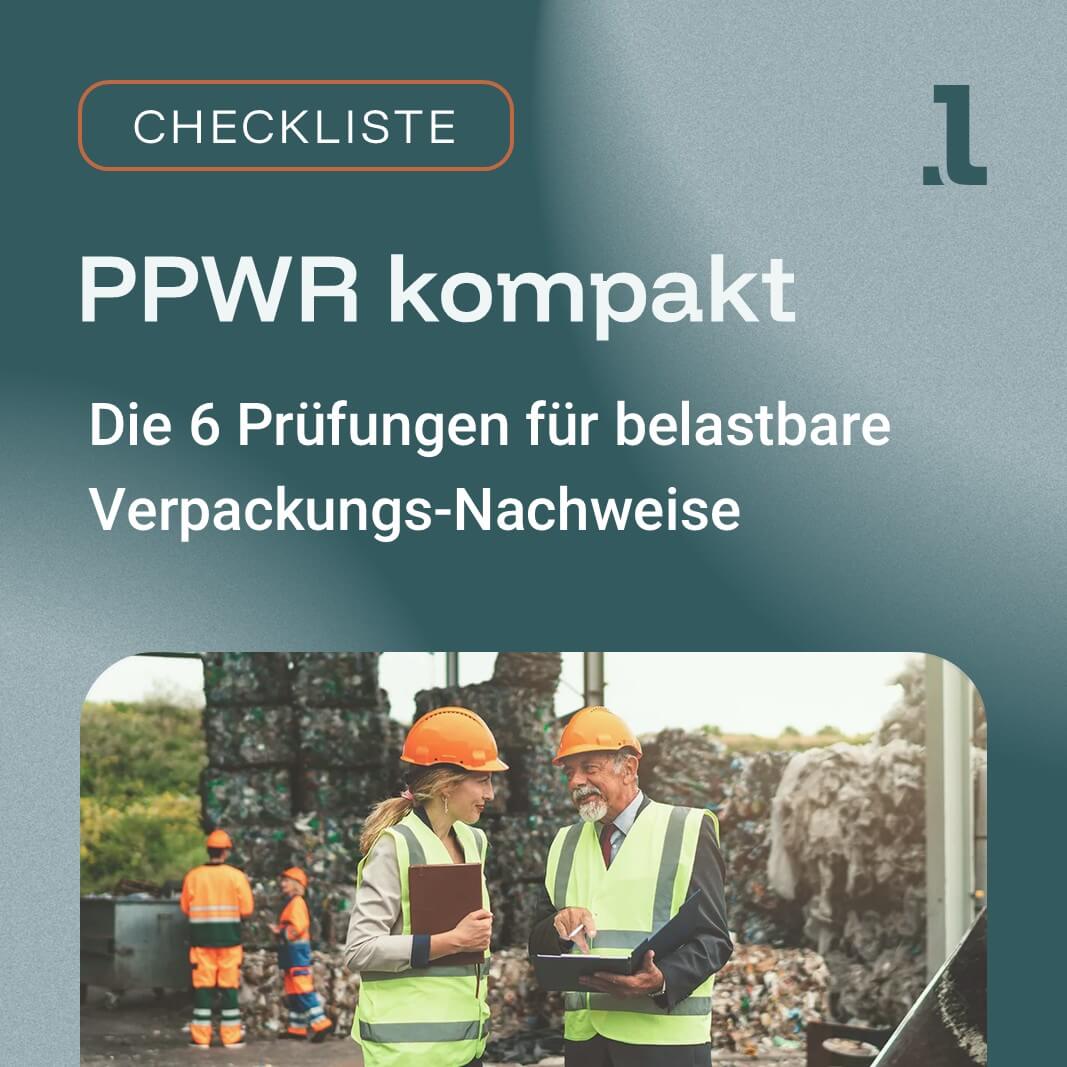
In this checklist, you will learn:
-
Which of your packaging types are covered by the PPWR and which roles are relevant
-
How to assign packaging data and evidence to the right entity and create a Declaration of Conformity
-
How to record and centralise your packaging data in a structured way and avoid compliance risks early
You enjoyed reading our article?
Share it with your network via LinkedIn, email or WhatsApp!
More expert articles from our magazine
PPWR – What companies need to know about the regulation in 2026
The PPWR is the new EU packaging regulation, and it fundamentally changes the requirements for packaging in Europe. For your company, the key is not only to design packaging in a compliant way, but also to maintain reliable data and documentation, together with the necessary evidence. In this article, you will learn what the PPWR covers, who is affected, and how you can implement the new requirements in a structured way.

Product Carbon Footprint – the CO2 footprint of your products
How visible is your products’ climate impact, really? Discover what a Product Carbon Footprint is, how it differs from the CCF, and why it is becoming increasingly important – especially for companies with physical products and complex supply chains. The article also shows which data feeds into the calculation and where the biggest challenges lie in practice.

EmpCo Directive: What matters now for mid-market businesses
The EmpCo Directive requires companies to make environmental and sustainability claims more transparent and verifiable. In future, sustainability claims must be supported by evidence. Inaccurate or misleading claims can quickly become costly. Find out how to take the right precautions now.
FAQs on PPWR recyclability
Questions and answers on PPWR recyclability
If you have any unanswered questions about PPWR recyclability, please email us at kontakt@leadity.de
Under the PPWR’s recyclability requirement, all packaging placed on the market must be recyclable. More specifically, packaging is recyclable under the PPWR if the raw materials recovered through recycling are of sufficient quality to replace virgin raw materials. The packaging must also be suitable for separate collection and sorting and be recyclable at scale. It must not contaminate other waste streams.
The general obligation has applied since 12 August 2026. The Design for Recycling requirements apply from 1 January 2030 or 24 months after the relevant EU legal acts enter into force. Recycling at scale becomes relevant from 2035 or five years after the corresponding legal acts enter into force. From 2038, only grades A or B will generally be permitted.
The manufacturer assesses recyclability and documents conformity. Suppliers must provide the information and documentation needed for this. Importers and distributors have their own verification and due diligence obligations.
The requirements may apply to a wide range of actors. The PPWR generally covers packaging placed on the EU market, whether it is empty or filled and regardless of the material it is made from. This means secondary, transport and shipping packaging may also be affected. A company’s specific obligations depend on its role in the supply chain.
In principle, the recyclability requirement applies to all packaging placed on the EU market. Micro-enterprises are subject to a special rule: Under certain conditions, the packaging supplier is considered the manufacturer.
Start by taking stock of your packaging and clarifying who in your company is responsible for the assessment. Document materials and components, request missing information from suppliers and assess the packaging against the applicable EU criteria. Record the assessment status and open questions so you can update the assessment if the criteria change.
Recyclability describes whether packaging can be collected, sorted and recycled. The minimum recycled content requirement specifies how much recycled plastic a plastic package must contain.
Yes. The general recyclability obligation has applied since 12 August 2026. Companies should now take stock of their packaging portfolio, clarify responsibilities and gather missing material and supplier data. The assessment criteria and requirements for recycling at scale will apply in stages at later dates.